Quiet Tone Official Website › Supplement facts
Supplement factsQuiet Tone Supplement Facts
The Quiet Tone panel prints ten rows against a serving of one capsule.
Nine are vitamins and minerals with an amount and a percentage of the Daily Value each. The tenth is a Proprietary Blend of 415.5 mg covering 18 botanicals and amino acids, footnoted as having no established Daily Value. Three inactive entries sit beneath.
Reproduced in full so this page can be held against the bottle rather than replacing it.
The Quiet Tone Supplement Facts panel, exactly as printed
Ten rows and one other-ingredients line, reproduced so this page can be held against the bottle that arrives.
| Row | Amount per serving | % Daily Value |
|---|---|---|
| Thiamin (as Thiamine Mononitrate) | 6 mg | 500% |
| Riboflavin (Vitamin B2) | 6 mg | 462% |
| Niacin (as Niacin) | 14 mg NE | 88% |
| Vitamin B6 (as Pyridoxine HCl) | 4 mg | 236% |
| Biotin | 150 mcg | 500% |
| Pantothenic Acid (as D-Calcium Pantothenate) | 8 mg | 160% |
| Calcium (as Calcium Carbonate) | 12.5 mg | 1% |
| Magnesium (as Magnesium Oxide) | 12.5 mg | 3% |
| Zinc (as Zinc Oxide) | 12.5 mg | 114% |
| Proprietary Blend | 415.5 mg | † |
Serving size 1 capsule. Servings per container 30. The blend row carries a double-asterisk footnote on the artwork reading “Daily Value (DV) not established”; it is set as a dagger here so it cannot be mistaken for a claim marker.
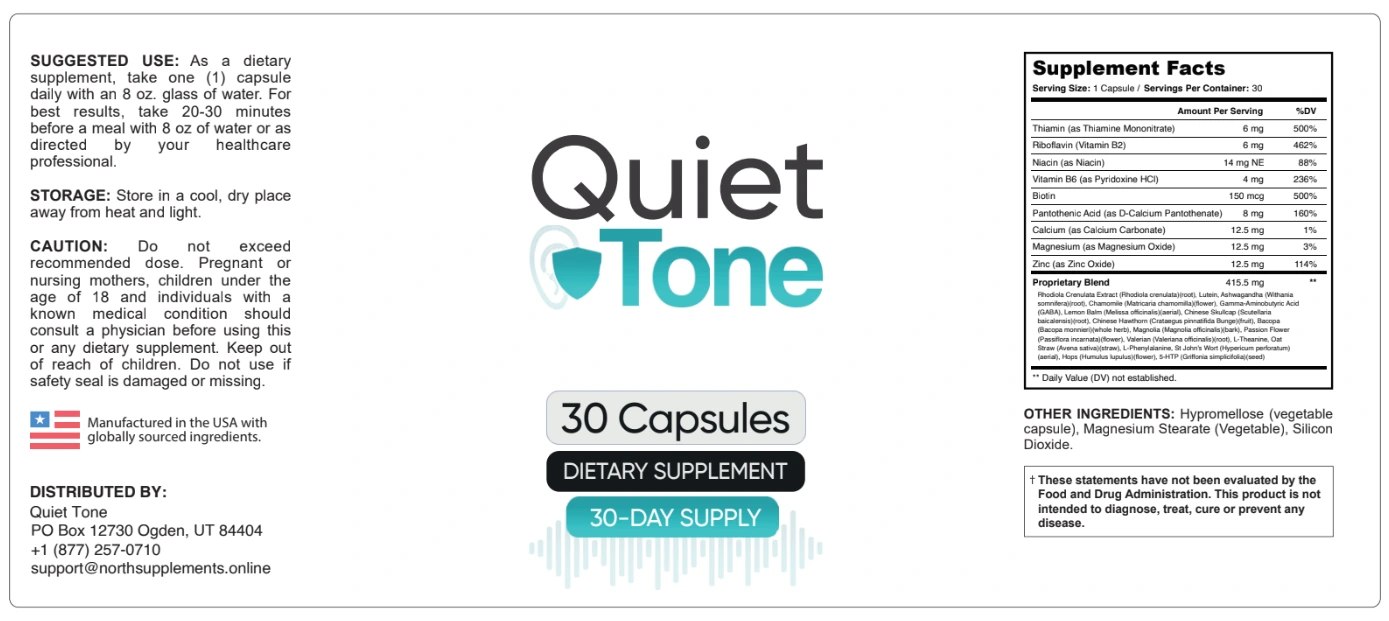
Other ingredients, printed beneath the panel: hypromellose (vegetable capsule), magnesium stearate (vegetable), silicon dioxide. Three entries, and the first of them is the capsule shell.
Hypromellose is made from plant cellulose, which settles the question buyers ask first: this is a vegetable capsule rather than a gelatin one. The stearate is specified as the vegetable-sourced grade and the silicon dioxide is a mineral anti-caking agent.
What the % Daily Value column on the Quiet Tone panel means
What a Daily Value is, what it is not, and why several rows sit far above a hundred.
The right-hand column is the one people read fastest and misread most often. A Daily Value is a single reference figure for the whole adult population, printed so that one product can be compared with another without anyone doing arithmetic.
It is not a dose and it is not a target. A hundred per cent means the amount matches the reference figure. Above a hundred means more than the reference figure, which for a water-soluble vitamin is ordinary rather than remarkable, because the excess is excreted rather than stored.
| What the column says here | How to read it |
|---|---|
| 500% (thiamin), 500% (biotin), 462% (riboflavin) | Several times a reference intake, which is normal formulation practice for a B complex. These three are water-soluble and cleared readily. |
| 236% (vitamin B6), 160% (pantothenic acid) | Comfortably above the reference figure. B6 at 4 mg is a nutritional amount; the concerns attached to long-term high-dose B6 belong to amounts hundreds of times larger. |
| 114% (zinc) | A full day of zinc and a little over. The number worth adding up against any other zinc in the cupboard, because this is already the whole day. |
| 88% (niacin) | Just under a day, expressed as niacin equivalents, which is the standard unit because the body also makes niacin from tryptophan. |
| 3% (magnesium), 1% (calcium) | Trace amounts. The label is doing the work here: the percentage says more plainly than any sentence could that these two rows are present rather than substantial. |
| † (Proprietary Blend) | Footnoted “Daily Value (DV) not established”, which is the correct notation for a mixture of botanicals that has no reference intake. It is a notation about the reference figure, not about the amount. |
The percentages are the label’s own arithmetic and are reproduced as printed rather than recalculated here.
A dagger beside the blend row is often read as a warning. It is not. It records that no Daily Value exists for a botanical mixture, which is true of every botanical on every label. The question the blend row raises is about individual amounts, and it is dealt with two sections down.
The Quiet Tone blend row, and the eighteen names inside it
The blend list in label order, and the one clue that order gives about the split.
One row, 415.5 mg, and 18 names beneath it in the order the formulator listed them. An ingredient declaration runs in descending order of weight, so the sequence is a real piece of information even though the split is not.
- Rhodiola Crenulata Extract (Rhodiola crenulata) (root)
- Lutein
- Ashwagandha (Withania somnifera) (root)
- Chamomile (Matricaria chamomilla) (flower)
- Gamma-Aminobutyric Acid (GABA)
- Lemon Balm (Melissa officinalis) (aerial)
- Chinese Skullcap (Scutellaria baicalensis) (root)
- Chinese Hawthorn (Crataegus pinnatifida Bunge) (fruit)
- Bacopa (Bacopa monnieri) (whole herb)
- Magnolia (Magnolia officinalis) (bark)
- Passion Flower (Passiflora incarnata) (flower)
- Valerian (Valeriana officinalis) (root)
- L-Theanine
- Oat Straw (Avena sativa) (straw)
- L-Phenylalanine
- St John's Wort (Hypericum perforatum) (aerial)
- Hops (Humulus lupulus) (flower)
- 5-HTP (Griffonia simplicifolia) (seed)
Read that order and three things follow. Rhodiola crenulata extract and lutein carry the two largest shares. L-theanine sits thirteenth, which places it below eight botanicals whose own trials ran at hundreds of milligrams. Hops and 5-HTP are last, and last of eighteen inside 415.5 mg is a small number however it is divided.
Eleven of the eighteen name the plant part in brackets, and two of those parts change which research can be cited at all. Both cases are set out on the ingredients page, which is where the forms and the parts are the subject.
What else the Quiet Tone artwork prints
Six blocks of text beyond the panel, each quoted once in the place where it belongs.
Suggested use
“As a dietary supplement, take one (1) capsule daily with an 8 oz. glass of water. For best results, take 20–30 minutes before a meal with 8 oz of water or as directed by your healthcare professional.” Eight ounces of water is specified twice in one sentence, which is unusual on artwork where space is expensive.
Storage
“Store in a cool, dry place away from heat and light.” A kitchen shelf away from the hob satisfies it; a bathroom windowsill and a car glovebox do not.
Caution
“Do not exceed recommended dose. Pregnant or nursing mothers, children under the age of 18 and individuals with a known medical condition should consult a physician before using this or any dietary supplement. Keep out of reach of children. Do not use if safety seal is damaged or missing.” This is the label’s own wording and it is quoted once rather than restated in five places.
Origin
“Manufactured in the USA with globally sourced ingredients.” Assembly is domestic and sourcing is not, which is what the wording says and what the pack’s ingredients seal repeats.
Distributed by
Quiet Tone, PO Box 12730 Ogden, UT 84404, with +1 (877) 257-0710 and [email protected] beside it. That block belongs to whoever printed the label and differs from this desk’s own details. Both are set out on the batch page.
The FDA statement
“These statements have not been evaluated by the Food and Drug Administration. This product is not intended to diagnose, treat, cure or prevent any disease.” Required on the category and reproduced in the footer of every page here.
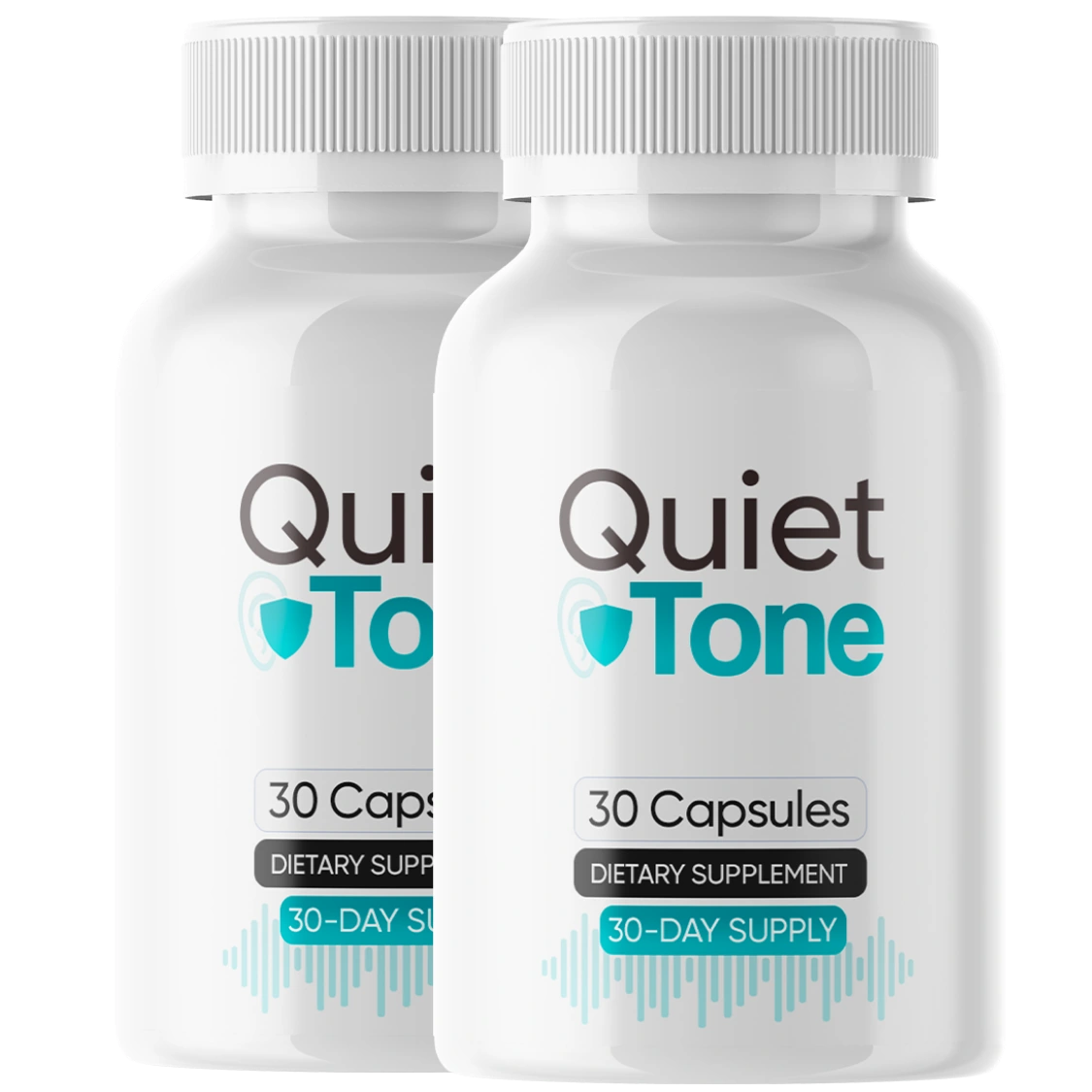
What is absent from that list is the interesting part. There is no structure or function sentence anywhere on the artwork: no supports hearing, no mention of ringing, ears or sleep. The auditory signal on the bottle is visual, an ear-in-shield mark and a waveform, and the benefits page works through what follows from that.
Which Quiet Tone rows can be checked, and which cannot
Two standards of proof on one bottle, and the five rows where the difference bites.
The quarantine section, and the shortest way to put it is that this bottle carries two labels with different standards of proof.
The top nine rows are auditable. Each one names an amount, a chemical form and a percentage, and any reader can set that beside a published reference intake without asking anyone's permission. Nine rows out of twenty-seven actives.
The tenth row is not. 415.5 mg covers 18 ingredients, listed in descending order and nothing more precise. Split evenly it averages about 23 mg each, and no formulator is obliged to split evenly.
Those five rows are where the panel meets the category it is sold into. Zinc at 12.5 mg is a quarter of an amount that already failed its own tinnitus trial, and the Cochrane review found no evidence across three studies. Magnesium at 12.5 mg is roughly a thirteenth of its noise-exposure trial dose.
Read as nutrition rather than as treatment, the same rows read differently: 114% of a day of zinc is a sound intake and the label prints the figure itself. Both readings are true and they answer different questions.
How to check your Quiet Tone bottle against this page
Five checks that take two minutes with the bottle in one hand.
Compare the ten rows
Amount and percentage, row by row. A panel that differs from the table above is worth reporting rather than assuming this page is stale, and corrections go to [email protected].
Count the names inside the blend
18 of them, in the order printed above. The order carries the only information there is about the split, so a reordered list is a different formula.
Read the other-ingredients line
Three entries: hypromellose (vegetable capsule), magnesium stearate (vegetable), silicon dioxide. This is the line that decides the gelatin question and the one a buyer with a dietary restriction is entitled to rely on.
Find the lot on the base
Bottles shipped from this desk carry lot QUI-26/GO-5005, held against certificate reference QUI-5005-26-GO. The batch page sets out what those references establish and what they do not.
Check the safety seal before the first capsule
The caution says not to use the bottle if the seal is damaged or missing. That is a reason to call the order desk rather than to carry on.
Quiet Tone panel questions
What is on the Quiet Tone Supplement Facts panel?
Ten rows. Nine vitamins and minerals each with an amount and a percentage of the Daily Value, then one Proprietary Blend of 415.5 mg covering 18 botanicals and amino acids. Serving size is one capsule and a container holds thirty.
Why do some rows show more than 100%?
Because the amount is above the reference figure for that nutrient. For water-soluble B vitamins that is ordinary formulation practice: the excess is excreted rather than stored, which is why thiamin and biotin sit at 500%.
What does the dagger on the blend row mean?
It footnotes “Daily Value (DV) not established”, which is the correct notation for a botanical mixture that has no reference intake. It says nothing about the amount and it is not a warning.
How much of each blend ingredient is there?
The panel gives one figure, 415.5 mg, for all 18. The order is descending by weight, so rhodiola and lutein carry the largest shares and hops and 5-HTP the smallest, but no individual weight appears.
Is the capsule gelatin?
No. The other-ingredients line reads hypromellose (vegetable capsule), magnesium stearate (vegetable), silicon dioxide, and hypromellose is made from plant cellulose. Anyone who avoids gelatin capsules is not ruled out by this one.
Does the label claim anything about hearing?
Not in words. There is no structure or function sentence anywhere on the artwork. The ear-in-shield mark and the waveform on the front are a visual signal, and the ringing-ears framing belongs to the seller’s sales pages.
What does the caution block say?
“Do not exceed recommended dose. Pregnant or nursing mothers, children under the age of 18 and individuals with a known medical condition should consult a physician before using this or any dietary supplement. Keep out of reach of children. Do not use if safety seal is damaged or missing.” That is the label’s own wording, quoted in full.
Sources for reading the Quiet Tone panel
The six studies this page sets beside a printed amount.
- Coelho C, Witt SA, Ji H, et al. Zinc to treat tinnitus in the elderly: a randomized placebo controlled crossover trial. Otol Neurotol. 2013;34(6):1146-54. PMID 23598691. https://pubmed.ncbi.nlm.nih.gov/23598691/
- Person OC, Puga ME, da Silva EM, et al. Zinc supplementation for tinnitus. Cochrane Database Syst Rev. 2016;11(11):CD009832. PMID 27879981. https://pubmed.ncbi.nlm.nih.gov/27879981/
- Attias J, Weisz G, Almog S, et al. Oral magnesium intake reduces permanent hearing loss induced by noise exposure. Am J Otolaryngol. 1994;15(1):26-32. PMID 8135325. https://pubmed.ncbi.nlm.nih.gov/8135325/
- Hulshof JH, Vermeij P. The effect of nicotinamide on tinnitus: a double-blind controlled study. Clin Otolaryngol Allied Sci. 1987;12(3):211-4. PMID 2955964. https://pubmed.ncbi.nlm.nih.gov/2955964/
- Durga J, Verhoef P, Anteunis LJ, et al. Effects of folic acid supplementation on hearing in older adults: a randomized, controlled trial. Ann Intern Med. 2007;146(1):1-9. PMID 17200216. https://pubmed.ncbi.nlm.nih.gov/17200216/
- Singh C, Kawatra R, Gupta J, et al. Therapeutic role of Vitamin B12 in patients of chronic tinnitus: A pilot study. Noise Health. 2016;18(81):93-7. PMID 26960786. https://pubmed.ncbi.nlm.nih.gov/26960786/
Order Quiet Tone with the whole panel in front of you
Nine printed amounts, an eighteen-part blend, 30 capsules a bottle and 180 days from purchase to change your mind.
Two bottles $158 · six bottles $294 · 180-day money-back guarantee
Order Quiet Tone On The Official WebsiteOne capsule a day · 30 per bottle · lot QUI-26/GO-5005