Quiet Tone Official Website › How it works
How it worksHow Does Quiet Tone Work?
Quiet Tone stacks three separate proposals on one panel, and they do not stand or fall together.
Nine printed vitamin and mineral rows make a nutrient-adequacy case. Fourteen of the eighteen blend names are traditional sleep and stress botanicals working on one inhibitory system. Zinc and magnesium are the only two with ear research, and both sit well below their trial amounts.
Three propositions on one bottle, separated so each can be judged on its own evidence.
What is Quiet Tone actually proposing?
One panel, three propositions, and three different weights of evidence behind them.
Three separate propositions are stacked on one panel, and they do not stand or fall together. Reading them apart is the only way to judge the bottle fairly.
The first is nutritional: nine vitamins and minerals at amounts a reference intake can be checked against. The second is the calm-and-sleep route, which is where fourteen of the eighteen blend names live. The third is the pair with ear-specific research, zinc and magnesium, and it is the narrowest of the three.
| The proposal | What it rests on | How strong the evidence is |
|---|---|---|
| Nutrient adequacy | Nine printed amounts against published reference intakes. | Settled science about the nutrients. It says nothing about what happens to anyone already meeting those intakes. |
| A calmer, better-slept evening | Fourteen botanicals and amino acids with human trials in sleep, stress or anxiety. | Real for several of the ingredients at their own doses. The pooled insomnia analysis and the anxiety network meta-analysis are where that literature sits. |
| Something ear-specific | Zinc and magnesium, the only two ingredients here tested for hearing outcomes. | Weak, and in zinc's case negative. The Cochrane review found no evidence across three trials. |
Three columns because three different questions are being asked, and conflating them is how a nutrient panel turns into a promise.
A reader who wants only the first proposition is buying a multivitamin with a long tail. A reader who wants the second is buying a calming blend whose individual amounts are shared. A reader who wants the third should read the zinc paragraph below before anything else on this website.
How is the Quiet Tone blend supposed to calm an evening?
Most of this blend is proposed to work on one inhibitory system, and several parts of it have human trials.
Fourteen of the eighteen blend names belong to the traditional calm-and-sleep shelf, and most of them are proposed to work through the same neurotransmitter system. Gamma-aminobutyric acid is the brain's principal inhibitory signal: when it binds its receptor, neurons fire less readily.
Valerian, hops, passion flower, chamomile and lemon balm are all described in the literature as acting somewhere on that system, whether by binding the receptor directly, by slowing the breakdown of the neurotransmitter, or by both. L-theanine is proposed differently again, as a modulator that raises alpha-wave activity without sedating.
Valerian and hops, the old pairing
Nearly always studied together, which is a problem for anyone trying to separate them. The 530 mg twice-daily trial tested valerian alone after surgery; the combination feasibility trial tested the pair as one extract. The umbrella review of valerian for insomnia is the sober summary, and it is not an enthusiastic one.
Chamomile and lemon balm, the two teas
Both have modern trials rather than folklore alone. Chamomile ran for twelve weeks in generalised anxiety disorder at 1,500 mg a day, and a lemon balm phytosome crossover study measured sleep quality directly. Trial doses and blend shares are compared on the ingredients page.
L-theanine, the amino acid in tea
The best-evidenced calming ingredient on this panel. A four-week randomised trial at 200 mg a day reported improvements in stress-related symptoms and sleep in healthy adults, and a study in middle-aged and older adults used a comparable amount.
Passion flower, magnolia and the rest
Passiflora incarnata has a systematic review covering neuropsychiatric use. For magnolia bark the human record that came back was oral-hygiene work, so this desk makes no calming claim for it. GABA taken by mouth returned no usable controlled trial either.
The honest summary of that group is that the ingredients are real, the trials are real, and the doses those trials used are set out beside the blend total on the ingredients page rather than here, where the subject is how the thing is supposed to work rather than how much of it there is.
How does the serotonin side of Quiet Tone fit together?
Three ingredients on one pathway, plus the vitamin the conversion step requires.
This is the part of the panel that shows a formulator thinking, and it is also the part that carries the safety consequences. Three ingredients sit on one pathway and a fourth is its cofactor.
5-HTP is 5-hydroxytryptophan, the immediate precursor the body converts into serotonin. The enzyme that performs that step, aromatic L-amino acid decarboxylase, requires vitamin B6 in its active coenzyme form. This panel carries 5-HTP inside the blend and B6 at 4 mg, 236% of the Daily Value, on the row above it.
St John's wort is the third. Its depression meta-analysis is the reason it is on a calming label at all, and its proposed action includes serotonergic effects among several others. L-phenylalanine, the fourth, is an amino acid precursor on the catecholamine side rather than the serotonin one, and searches returned nothing bearing on sleep, calm or hearing for it.
- 5-HTP (Griffonia seed), the serotonin precursor, eighteenth on the blend list and therefore the smallest share of it.
- Vitamin B6 as pyridoxine hydrochloride, 4 mg, the cofactor that conversion step needs.
- St John’s wort (aerial), sixteenth on the blend list, with serotonergic activity among its proposed effects.
- L-phenylalanine, fifteenth, an amino acid this desk claims nothing for.
Two serotonergic ingredients in one daily capsule is a combination worth raising with a prescriber by anyone already taking an antidepressant. The 5-HTP review covers the physiology and the toxicology, and the side effects page names the specific interactions rather than gesturing at them.
What are zinc and magnesium doing in Quiet Tone?
The narrowest of the three proposals, and the only one aimed at the ear itself.
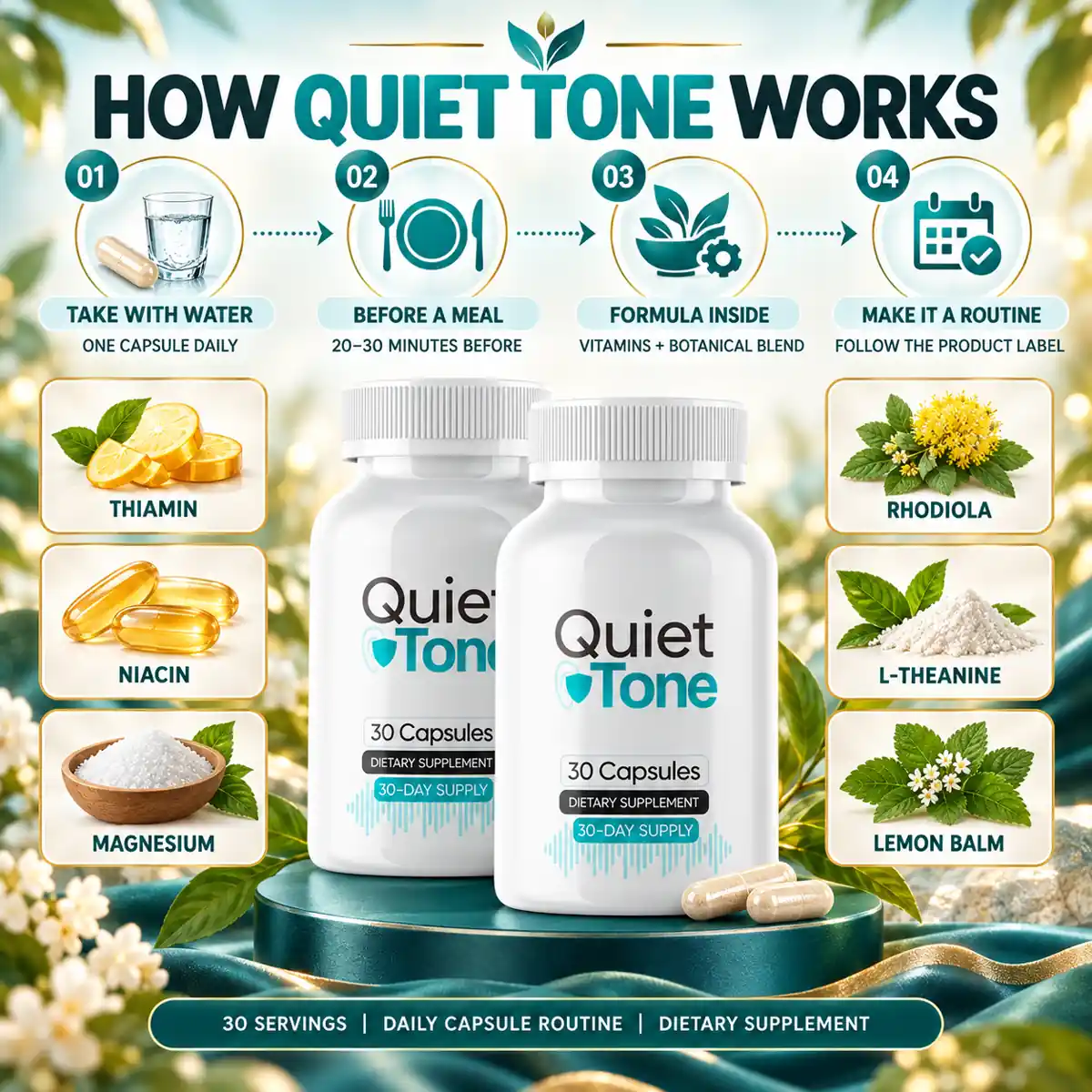
These two are the only ingredients on the entire panel that have been tested against hearing outcomes in their own right, which makes them the most important rows on the label and the most uncomfortable.
Zinc is concentrated in cochlear tissue and has been proposed as a tinnitus treatment for decades. The crossover trial in older adults gave 50 mg a day for four months and concluded that zinc is not an effective treatment. The Cochrane review pooled three trials and 209 participants and found no evidence of benefit, at very low quality. This panel carries 12.5 mg.
Magnesium has the better story and the thinner evidence. An oral magnesium trial in people exposed to loud noise used 167 mg a day and reported less permanent hearing loss, and a later trial tested it in sudden hearing loss. This panel carries 12.5 mg of magnesium oxide, and prints 3% of the Daily Value beside it.
What is the adaptogen group in Quiet Tone proposing?
Three ingredients whose proposal is about the stress response rather than sedation.
Three of the eighteen are sold in the adaptogen category: ashwagandha, rhodiola and bacopa. The shared proposition is that they blunt the physiological response to stress rather than acting as sedatives, which is a different claim from the one the calming group makes.
Ashwagandha has the most modern activity behind it. A dose-ranging trial at 250 and 600 mg a day reported anxiolytic effects in healthy adults, a meta-analysis pooled the stress and anxiety work, and a second meta-analysis found it lowered cortisol without moving perceived stress. That last distinction is the most useful thing in the group: a hormone moved is not a symptom moved. NCCIH's own page covers the safety picture, including the liver reports.
Bacopa is proposed for cognition over months rather than calm over hours. A twelve-week trial at 300 mg a day missed its primary endpoint, and a systematic review surveys the older work. The rhodiola is crenulata, and the one synthesis specific to that species is about acute altitude sickness rather than stress.
Read together, the adaptogen group is the part of this blend with the most active modern research and the least connection to the ear. Nothing in it has been tested against tinnitus, and nobody claims it has.
Why is there lutein in Quiet Tone?
The best-evidenced ingredient in the blend, studied for a different organ entirely.
Lutein is second on the blend list, which by descending order makes it one of the two largest shares of the 415.5 mg. It is also the ingredient here whose evidence is strongest and whose organ is furthest from the ear.
It is a carotenoid that accumulates in the macula of the retina. The AREDS2 analysis used 10 mg a day alongside zeaxanthin and measured progression of macular degeneration, and the Cochrane review of antioxidant supplements in that condition is the wider picture.
There is no hearing or tinnitus literature for lutein, and this desk does not suggest one exists. It is on this panel as a carotenoid, at a share nobody can size, in a product sold for something else. Saying that plainly costs nothing and is more useful than a sentence stretched to make it fit.
What the Quiet Tone mechanism cannot tell you
The distance between a plausible route and a measured result, stated once.
Everything above is a mechanism, and a mechanism is a story about how something might work. It is not a result. The gap between the two is where most of this category's marketing lives, so it is worth naming in the section whose job that is.
Four things follow from the panel as printed. Each ingredient's proposed action is documented for that ingredient at the dose its own trials used. None of those doses is knowable here for the eighteen inside the blend. No trial has been run on this finished capsule. And nothing about a combination can be inferred from its parts without testing it, which the critical appraisal of herbal remedy evaluation sets out at length.
The category's own clinical practice guideline is stricter still, and it is quoted in full and in context in the complaints section of the home page. Nothing on this website sits above that line.
What the panel supports
- Nine nutrient amounts that can be checked against a reference intake.
- Named plant parts for eleven of the eighteen blend ingredients.
- Real human trials behind several of the calming ingredients.
- A coherent pairing of 5-HTP with the B6 its conversion needs.
- A vegetable capsule, one a day, with no sugar or flavouring to account for.
What it leaves open
- No individual weight for any of the eighteen blend ingredients.
- No extraction ratio or standardisation marker on any botanical row.
- No trial of the finished formula, at any dose, for any outcome.
- Zinc at a quarter of an amount that failed its own tinnitus trial.
- Magnesium at roughly a thirteenth of its noise-exposure trial dose.
Questions about how Quiet Tone works
How does Quiet Tone work?
It proposes three separate things at once: nutrient adequacy from nine printed vitamin and mineral rows, a calmer evening from fourteen traditional sleep and stress botanicals, and two minerals with ear-specific research behind them. The three rest on very different weights of evidence and this page keeps them apart.
Does Quiet Tone work on the ear directly?
Only zinc and magnesium have been tested for hearing outcomes at all, and both are printed here at a fraction of their trial amounts. The rest of the panel works, if it works, on sleep and the stress response rather than on the ear.
How fast would any of this be expected to act?
Nothing on this panel is a stimulant and nothing acts in a day. The shortest relevant trial ran four weeks. The results timeline sets the trial durations beside what buyers report.
Why is vitamin B6 at 236% of the Daily Value?
B6 is the cofactor for the enzyme that converts 5-HTP into serotonin, and 5-HTP is one of the eighteen blend ingredients. Water-soluble B vitamins are routinely formulated well above 100% because the excess is excreted rather than stored.
Is a proprietary blend a mechanism problem or a dosage problem?
Both, in sequence. The mechanism of each named ingredient is documented at the dose its trials used; without an individual weight there is no way to say whether this capsule reaches that dose. The arithmetic is on the ingredients page.
Has Quiet Tone itself been tested in a trial?
No trial of this finished formula has been published. Every study cited on this website is about a named ingredient at a stated dose, and each one is labelled that way rather than borrowed for the capsule.
Sources for how Quiet Tone is said to work
Grouped by the route each study belongs to, in the order the page takes them.
- Leach MJ, Page AT. Herbal medicine for insomnia: A systematic review and meta-analysis. Sleep Med Rev. 2015;24:1-12. PMID 25644982. https://pubmed.ncbi.nlm.nih.gov/25644982/
- Zhang W, Yan Y, Wu Y, et al. Medicinal herbs for the treatment of anxiety: A systematic review and network meta-analysis. Pharmacol Res. 2022;179:106204. PMID 35378276. https://pubmed.ncbi.nlm.nih.gov/35378276/
- Izzo AA, Hoon-Kim S, Radhakrishnan R, et al. A Critical Approach to Evaluating Clinical Efficacy, Adverse Events and Drug Interactions of Herbal Remedies. Phytother Res. 2016;30(5):691-700. PMID 26887532. https://pubmed.ncbi.nlm.nih.gov/26887532/
- Person OC, Puga ME, da Silva EM, et al. Zinc supplementation for tinnitus. Cochrane Database Syst Rev. 2016;11(11):CD009832. PMID 27879981. https://pubmed.ncbi.nlm.nih.gov/27879981/
- Coelho C, Witt SA, Ji H, et al. Zinc to treat tinnitus in the elderly: a randomized placebo controlled crossover trial. Otol Neurotol. 2013;34(6):1146-54. PMID 23598691. https://pubmed.ncbi.nlm.nih.gov/23598691/
- Attias J, Weisz G, Almog S, et al. Oral magnesium intake reduces permanent hearing loss induced by noise exposure. Am J Otolaryngol. 1994;15(1):26-32. PMID 8135325. https://pubmed.ncbi.nlm.nih.gov/8135325/
- Nageris BI, Ulanovski D, Attias J. Magnesium treatment for sudden hearing loss. Ann Otol Rhinol Laryngol. 2004;113(8):672-5. PMID 15330150. https://pubmed.ncbi.nlm.nih.gov/15330150/
- Zare Elmi HK, Gholami M, Saki M, et al. Efficacy of Valerian Extract on Sleep Quality after Coronary Artery bypass Graft Surgery: A Triple-Blind Randomized Controlled Trial. Chin J Integr Med. 2021;27(1):7-15. PMID 33420602. https://pubmed.ncbi.nlm.nih.gov/33420602/
- Valente V, Machado D, Jorge S, et al. Does valerian work for insomnia? An umbrella review of the evidence. Eur Neuropsychopharmacol. 2024;82:6-28. PMID 38359657. https://pubmed.ncbi.nlm.nih.gov/38359657/
- Schicktanz N, Gerhards C, Schlitt T, et al. Effects of a Valerian-Hops Extract Combination (Ze 91019) on Sleep Duration and Daytime Cognitive and Psychological Parameters in Occasional Insomnia: A Randomized Controlled Feasibility Trial. Brain Behav. 2025;15(6):e70600. PMID 40462685. https://pubmed.ncbi.nlm.nih.gov/40462685/
- Mao JJ, Xie SX, Keefe JR, et al. Long-term chamomile (Matricaria chamomilla L.) treatment for generalized anxiety disorder: A randomized clinical trial. Phytomedicine. 2016;23(14):1735-1742. PMID 27912875. https://pubmed.ncbi.nlm.nih.gov/27912875/
- Di Pierro F, Sisti D, Rocchi M, et al. Effects of Melissa officinalis Phytosome on Sleep Quality: Results of a Prospective, Double-Blind, Placebo-Controlled, and Cross-Over Study. Nutrients. 2024;16(23). PMID 39683592. https://pubmed.ncbi.nlm.nih.gov/39683592/
- Hidese S, Ogawa S, Ota M, et al. Effects of L-Theanine Administration on Stress-Related Symptoms and Cognitive Functions in Healthy Adults: A Randomized Controlled Trial. Nutrients. 2019;11(10). PMID 31623400. https://pubmed.ncbi.nlm.nih.gov/31623400/
- Baba Y, Inagaki S, Nakagawa S, et al. Effects of l-Theanine on Cognitive Function in Middle-Aged and Older Subjects: A Randomized Placebo-Controlled Study. J Med Food. 2021;24(4):333-341. PMID 33751906. https://pubmed.ncbi.nlm.nih.gov/33751906/
- Janda K, Wojtkowska K, Jakubczyk K, et al. Passiflora incarnata in Neuropsychiatric Disorders-A Systematic Review. Nutrients. 2020;12(12). PMID 33352740. https://pubmed.ncbi.nlm.nih.gov/33352740/
- Maffei ME. 5-Hydroxytryptophan (5-HTP): Natural Occurrence, Analysis, Biosynthesis, Biotechnology, Physiology and Toxicology. Int J Mol Sci. 2020;22(1). PMID 33375373. https://pubmed.ncbi.nlm.nih.gov/33375373/
- Ng QX, Venkatanarayanan N, Ho CY. Clinical use of Hypericum perforatum (St John's wort) in depression: A meta-analysis. J Affect Disord. 2017;210:211-221. PMID 28064110. https://pubmed.ncbi.nlm.nih.gov/28064110/
- Salve J, Pate S, Debnath K, et al. Adaptogenic and Anxiolytic Effects of Ashwagandha Root Extract in Healthy Adults: A Double-blind, Randomized, Placebo-controlled Clinical Study. Cureus. 2019;11(12):e6466. PMID 32021735. https://pubmed.ncbi.nlm.nih.gov/32021735/
- Arumugam V, Vijayakumar V, Balakrishnan A, et al. Effects of Ashwagandha (Withania Somnifera) on stress and anxiety: A systematic review and meta-analysis. Explore (NY). 2024;20(6):103062. PMID 39348746. https://pubmed.ncbi.nlm.nih.gov/39348746/
- Albalawi AA. Dual impact of Ashwagandha: Significant cortisol reduction but no effects on perceived stress - A systematic review and meta-analysis. Nutr Health. 2025;31(4):1395-1408. PMID 40746175. https://pubmed.ncbi.nlm.nih.gov/40746175/
- Ashwagandha. National Center for Complementary and Integrative Health, National Institutes of Health. https://www.nccih.nih.gov/health/ashwagandha
- Lopresti AL, Smith SJ. The Effects of a Bacopa monnieri Extract (Bacumen) on Cognition, Stress, and Fatigue in Healthy Adults: A Randomized, Double-Blind, Placebo-Controlled Trial. Clin Drug Investig. 2025;45(12):967-982. PMID 41091332. https://pubmed.ncbi.nlm.nih.gov/41091332/
- Basheer A, Agarwal A, Mishra B, et al. Use of Bacopa monnieri in the Treatment of Dementia Due to Alzheimer Disease: Systematic Review of Randomized Controlled Trials. Interact J Med Res. 2022;11(2):e38542. PMID 35612544. https://pubmed.ncbi.nlm.nih.gov/35612544/
- Gao Z, Liu Y, Liao W, et al. Efficacy and safety of Rhodiola crenulata extract in the treatment of acute high altitude disease, based on studies involving populations in China: A systematic review and meta-analysis. Front Pharmacol. 2025;16:1595953. PMID 40584626. https://pubmed.ncbi.nlm.nih.gov/40584626/
- Keenan TDL, Agron E, Keane PA, et al. Oral Antioxidant and Lutein/Zeaxanthin Supplements Slow Geographic Atrophy Progression to the Fovea in Age-Related Macular Degeneration. Ophthalmology. 2025;132(1):14-29. PMID 39025435. https://pubmed.ncbi.nlm.nih.gov/39025435/
- Evans JR, Lawrenson JG. Antioxidant vitamin and mineral supplements for slowing the progression of age-related macular degeneration. Cochrane Database Syst Rev. 2023;9(9):CD000254. PMID 37702300. https://pubmed.ncbi.nlm.nih.gov/37702300/
Order Quiet Tone knowing which proposal you are buying
Nine printed amounts, an eighteen-part blend, one capsule a day and 180 days from purchase to decide.
Two bottles $158 · six bottles $294 · 180-day money-back guarantee
Order Quiet Tone On The Official WebsiteOne capsule a day · 30 per bottle · lot QUI-26/GO-5005