Quiet Tone Official Website › Ingredients
IngredientsQuiet Tone Ingredients
Quiet Tone carries twenty-seven active ingredients across two very different halves of one panel.
Nine vitamins and minerals each print a weight and a percentage. The other eighteen are botanicals and amino acids sharing a single 415.5 mg blend line. Nine rows name a chemical form, eleven name a plant part, and three inactive entries sit underneath.
Every name on the bottle, the form it arrives as, and the part of the plant it came from.
What are the ingredients in Quiet Tone, in the order the label prints them?
Every row on the panel and every name inside the blend, reproduced in label order.
| Row | Amount per capsule | % Daily Value |
|---|---|---|
| Thiamin (as Thiamine Mononitrate) | 6 mg | 500% |
| Riboflavin (Vitamin B2) | 6 mg | 462% |
| Niacin (as Niacin) | 14 mg NE | 88% |
| Vitamin B6 (as Pyridoxine HCl) | 4 mg | 236% |
| Biotin | 150 mcg | 500% |
| Pantothenic Acid (as D-Calcium Pantothenate) | 8 mg | 160% |
| Calcium (as Calcium Carbonate) | 12.5 mg | 1% |
| Magnesium (as Magnesium Oxide) | 12.5 mg | 3% |
| Zinc (as Zinc Oxide) | 12.5 mg | 114% |
| Proprietary Blend | 415.5 mg | † |
Serving size one capsule, thirty servings a container. The blend row is footnoted on the artwork as “Daily Value (DV) not established”.
Ten rows, and the tenth is a door with eighteen names behind it. The first nine are vitamins and minerals, each with a weight and a percentage, and they occupy the top two-thirds of the printed panel.
Underneath them sits Proprietary Blend, 415.5 mg, followed by the eighteen botanicals and amino acids in this order: 1. Rhodiola Crenulata Extract (Rhodiola crenulata) (root), 2. Lutein, 3. Ashwagandha (Withania somnifera) (root), 4. Chamomile (Matricaria chamomilla) (flower), 5. Gamma-Aminobutyric Acid (GABA), 6. Lemon Balm (Melissa officinalis) (aerial), 7. Chinese Skullcap (Scutellaria baicalensis) (root), 8. Chinese Hawthorn (Crataegus pinnatifida Bunge) (fruit), 9. Bacopa (Bacopa monnieri) (whole herb), 10. Magnolia (Magnolia officinalis) (bark), 11. Passion Flower (Passiflora incarnata) (flower), 12. Valerian (Valeriana officinalis) (root), 13. L-Theanine, 14. Oat Straw (Avena sativa) (straw), 15. L-Phenylalanine, 16. St John's Wort (Hypericum perforatum) (aerial), 17. Hops (Humulus lupulus) (flower), 18. 5-HTP (Griffonia simplicifolia) (seed).
An ingredient declaration runs in descending order of weight, so rhodiola and lutein carry the largest shares of that figure and hops and 5-HTP the smallest. That sequence is the whole of what the artwork gives away about the split, and it is worth having: it rules out, for instance, a blend that is mostly L-theanine, because L-theanine sits thirteenth.
What the inside of a Quiet Tone capsule looks like
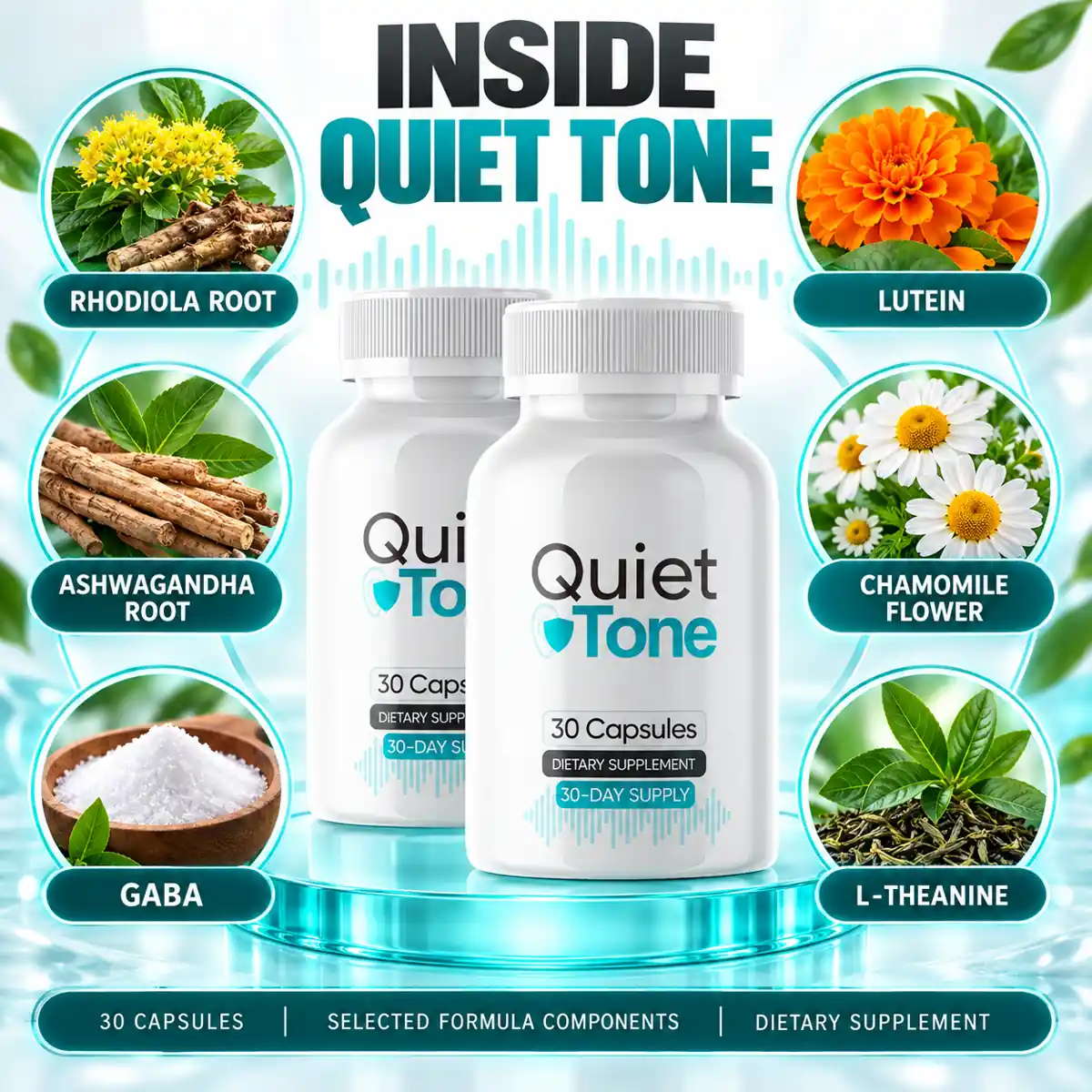
The seller's ingredient graphic shows a handful of the eighteen blend names arranged around the bottle. It is a marketing image rather than a panel, and the names it features are a selection rather than the list.
The panel above is the document that governs. Where the graphic and the printed Supplement Facts disagree on which ingredients are in the bottle, the Supplement Facts wins, and this desk has set the two side by side rather than picking the friendlier one.
What do the chemical forms on the Quiet Tone panel change?
Nine rows, nine named salts, and what each one decides about absorption.
Each of the nine nutrient rows names a form in brackets, and the brackets are the part most people skip. A mineral is not one substance: the salt it arrives as decides how much of it crosses the gut wall, and two products showing the same milligram figure can deliver quite different amounts.
| Row as printed | What that form is | What it changes |
|---|---|---|
| Thiamin (as Thiamine Mononitrate) | A stable synthetic salt of vitamin B1 | The standard form in multivitamins. Stable on a shelf, well absorbed at this size. |
| Riboflavin (Vitamin B2) | Riboflavin itself, no salt named | The plain vitamin. Turns urine bright yellow at amounts like this one, which surprises first-time buyers and is harmless. |
| Niacin (as Niacin) | Nicotinic acid, named twice for precision | This is the form that can flush the skin at gram doses. At 14 mg NE it does not, and naming it rules out the inositol hexanicotinate substitution some labels use. |
| Vitamin B6 (as Pyridoxine HCl) | The hydrochloride salt of pyridoxine | The common supplemental form, converted in the liver to the active coenzyme. It is also the cofactor the 5-HTP in the blend needs. |
| Biotin | Biotin itself | Well absorbed. High-dose biotin is known to interfere with some laboratory blood tests, which is worth mentioning to whoever draws them. |
| Pantothenic Acid (as D-Calcium Pantothenate) | The calcium salt of vitamin B5 | Standard and stable. It also means a second, unlisted trace of calcium arrives with this row. |
| Calcium (as Calcium Carbonate) | Chalk, the cheapest calcium salt | Absorbed best alongside food and stomach acid. At 12.5 mg the question is academic: the label prints 1% of a day beside it. |
| Magnesium (as Magnesium Oxide) | The oxide salt | The least absorbed of the common magnesium forms and the most laxative at scale. At 12.5 mg neither effect is in play, and the panel prints 3% beside it. |
| Zinc (as Zinc Oxide) | The oxide salt | Less bioavailable than zinc picolinate or citrate, and the form in a great many multivitamins. It still carries 114% of a day here. |
Forms read from the printed artwork. The comments are about the chemistry of each salt, not about what this capsule does.
Niacin as nicotinic acid is the flushing form, and that is why a label naming it twice is being careful rather than repetitive. The flush belongs to doses in the hundreds of milligrams. Fourteen is a nutritional amount and the one tinnitus trial of nicotinamide used the non-flushing amide form anyway.
Which plant parts are inside the Quiet Tone blend?
Eleven of the eighteen name a part in brackets, and two of those parts change what can be cited.
Eleven of the eighteen blend names carry a plant part in brackets, which is more than most labels in this aisle bother with. It matters because a plant is not one ingredient. Root, leaf, flower, bark, fruit and seed carry different chemistry and have usually been studied for different things.
| Ingredient, as the label writes it | Part named | Where its human research sits |
|---|---|---|
| Rhodiola Crenulata Extract (root) | Root | Acute altitude sickness. The crenulata meta-analysis is about mountains; the adaptogen literature people picture is on a different species, Rhodiola rosea. |
| Ashwagandha (Withania somnifera) (root) | Root | Root extracts are what the dose-ranging stress trial and the pooled anxiety analysis ran on, so the part lines up. |
| Chamomile (Matricaria chamomilla) (flower) | Flower | Flower heads are the studied material, including the long-term generalised anxiety trial. |
| Lemon Balm (Melissa officinalis) (aerial) | Aerial parts | Leaf and stem, which is what the sleep-quality crossover study used. |
| Chinese Skullcap (Scutellaria baicalensis) (root) | Root | Root is the traditional material and the source of baicalein, the compound in the only human work that came back. |
| Chinese Hawthorn (Crataegus pinnatifida) (fruit) | Fruit | The cardiology trials, including the WS 1442 benefit-risk review and the HERB CHF trial, ran on a leaf-and-flower extract of a different hawthorn species. |
| Bacopa (Bacopa monnieri) (whole herb) | Whole herb | Whole-plant extracts are standard in the cognitive trials, including the twelve-week study. |
| Magnolia (Magnolia officinalis) (bark) | Bark | Bark is the traditional part. Searches for human sleep or calm work returned oral hygiene studies and nothing usable here, so this desk claims nothing for it. |
| Passion Flower (Passiflora incarnata) (flower) | Flower | Aerial and flowering material is the studied form, surveyed in the neuropsychiatric systematic review. |
| Valerian (Valeriana officinalis) (root) | Root | Root, which is what the 530 mg sleep trial used and what the umbrella review summarises. |
| Oat Straw (Avena sativa) (straw) | Straw | Green oat herb, the material in the dose-ranging cognitive study. |
| St John’s Wort (Hypericum perforatum) (aerial) | Aerial parts | Flowering tops, the material behind the depression meta-analysis and behind the interaction literature. |
| 5-HTP (Griffonia simplicifolia) (seed) | Seed | Griffonia seed is the commercial source of 5-hydroxytryptophan, reviewed here. |
Parts read from the artwork. The right-hand column describes where each ingredient’s human research was done, not what this capsule contains of it.
Ten of those thirteen line up: the part in the brackets is the part the studies used. Two do not, and both are worth knowing before anyone quotes a trial at this bottle.
The rhodiola is crenulata rather than rosea, two different species whose literatures barely touch. Naming the species is the careful thing to do and this label does it, which is the reason the mismatch is visible at all.
The hawthorn is fruit. Every cardiology trial worth citing used a standardised extract of leaf with flower, from Crataegus monogyna and laevigata. Fruit preparations of Crataegus pinnatifida are a food and a traditional digestive, and the heart-failure evidence does not travel across that gap.
What does “extract” mean on the Quiet Tone label?
What an extract name has to carry before one product can be set against another.
Three rows use the word: Rhodiola Crenulata Extract at the head of the blend, and the extract preparations implied by several of the botanical names beneath it. An extract is a concentrate, made by pulling the soluble fraction of a plant into a solvent and drying what comes out.
Two numbers make an extract comparable to another one. The first is the ratio, written as 4:1 or 10:1, meaning how many kilograms of raw plant went into one kilogram of powder. The second is the standardisation marker, written as a percentage of a named compound: 5% rosavins, 2.5% withanolides, 0.8% apigenin.
This artwork carries neither, for any row. That is ordinary for a proprietary blend and it is the reason a milligram figure inside one cannot be compared with a milligram figure in a trial even when both are known. Ten milligrams of a 10:1 concentrate and ten milligrams of ground leaf are the same weight and different products.
- The plant and the part, which this label gives for eleven of the eighteen.
- The extraction ratio, so raw-herb equivalence can be worked out.
- A standardisation marker and its percentage, so batches can be compared.
- An individual weight, which a proprietary blend replaces with one shared total.
- The solvent, where it changes the fraction pulled out, as it does for hops.
Two of those four are present here and two are not, and the supplement facts page prints the panel exactly as it stands so anyone can check that against the bottle that arrives.
How much of each Quiet Tone blend ingredient is inside 415.5 mg?
One total, eighteen names, and the trial doses those same ingredients were studied at.
This is the section whose job is arithmetic, and it is confined here so the rest of the page can describe the capsule instead of arguing with it.
415.5 mg is the whole blend. Eighteen names share it. Divided evenly that is about 23 mg each, and no formulator is obliged to divide evenly: descending order is compatible with rhodiola taking 200 mg and the bottom six taking a milligram between them.
Six of those seven single-ingredient doses are larger on their own than the average share of the entire blend, and chamomile's is more than three times the blend itself. That comparison is not an accusation. It is the only honest way to hold a trial dose beside a label that gives one total.
The fair reading runs both ways. A formulator combining eighteen calming plants may believe the combination does something the parts do not, and a critical appraisal of how herbal remedies should be judged sets out how that claim would have to be tested. Nothing of that kind has been run on this capsule.
Nine rows can be audited against a reference intake. One row, 415.5 mg across 18 names, has to be taken on trust. Both halves are on the same bottle and only one of them is checkable.
What else is in a Quiet Tone capsule besides the actives?
Three entries under the panel, one of which answers the question buyers ask first.
Three entries sit under the panel: hypromellose (vegetable capsule), magnesium stearate (vegetable), silicon dioxide. Between them they are the shell and the two agents that keep a powder flowing through a filling machine.
Hypromellose, the shell
Hydroxypropyl methylcellulose, made from plant cellulose. It is the vegetarian alternative to a gelatin capsule, it dissolves in the stomach, and it carries no taste of its own. For anyone who rules out gelatin on dietary or religious grounds, this one entry settles the question in this bottle's favour.
Magnesium stearate (vegetable), the flow agent
A salt of stearic acid, present in fractions of a milligram, that keeps powder from sticking to the machinery. The label specifies the vegetable-sourced grade, which is the version that matters to a vegetarian buyer. The magnesium it contributes is negligible beside the 12.5 mg row on the panel.
Silicon dioxide, the anti-caking agent
Finely divided silica, used to stop eighteen botanical powders clumping into a brick over a shelf life. It passes through unabsorbed and is one of the most common excipients in the category.
What is absent from that list is as useful as what is on it. There is no sugar, no sweetener, no colour and no flavouring, which is the practical difference between a capsule and a gummy in this aisle. There is also no gelatin, no lactose and no soy lecithin among the three entries.
Quiet Tone ingredient questions
How many ingredients does Quiet Tone contain?
Twenty-seven actives in total: nine vitamins and minerals with an individual amount and a percentage each, then 18 botanicals and amino acids sharing one 415.5 mg blend figure. Three inactive entries sit beneath them: hypromellose (vegetable capsule), magnesium stearate (vegetable), silicon dioxide.
Does Quiet Tone use a proprietary blend?
Yes, for 18 of its ingredients. The nine nutrient rows each carry their own weight; everything botanical sits inside a single 415.5 mg line, listed in descending order of weight and nothing more precise than that.
Which ingredient is present in the largest amount?
The blend as a whole, at 415.5 mg, dwarfs every nutrient row. Within the blend, descending order puts Rhodiola Crenulata Extract first and lutein second. Among the nine printed rows, niacin at 14 mg NE is the largest by weight.
Is the rhodiola the same one used in the fatigue studies?
No. This label names Rhodiola crenulata. The adaptogen and fatigue literature people have read about is almost entirely Rhodiola rosea, a separate species, and the two are not interchangeable. Naming the species on the panel is what makes the difference visible.
Is the hawthorn the kind used in the heart trials?
Not the same preparation. The cardiology work used a standardised leaf-and-flower extract of European hawthorn. This row is the fruit of Crataegus pinnatifida, the Chinese species, traditionally a digestive food rather than a cardiac preparation.
Is Quiet Tone vegetarian?
The shell is hypromellose and the stearate is specified as vegetable, so nothing in the three inactive entries is animal-derived. Anyone avoiding gelatin capsules can take this one. The seals that ship on the pack are audited on testing and quality.
Does the capsule contain gluten, dairy or soy?
None of the three inactive entries is a gluten, dairy or soy source, and none of the twenty-seven actives is either. The artwork carries no allergen statement beyond the ingredient declaration itself, so that reading comes from the list rather than from a tested threshold.
Sources behind the Quiet Tone ingredient list
Each study named above, grouped the way the panel groups the ingredient it belongs to.
- Hulshof JH, Vermeij P. The effect of nicotinamide on tinnitus: a double-blind controlled study. Clin Otolaryngol Allied Sci. 1987;12(3):211-4. PMID 2955964. https://pubmed.ncbi.nlm.nih.gov/2955964/
- Gao Z, Liu Y, Liao W, et al. Efficacy and safety of Rhodiola crenulata extract in the treatment of acute high altitude disease, based on studies involving populations in China: A systematic review and meta-analysis. Front Pharmacol. 2025;16:1595953. PMID 40584626. https://pubmed.ncbi.nlm.nih.gov/40584626/
- Salve J, Pate S, Debnath K, et al. Adaptogenic and Anxiolytic Effects of Ashwagandha Root Extract in Healthy Adults: A Double-blind, Randomized, Placebo-controlled Clinical Study. Cureus. 2019;11(12):e6466. PMID 32021735. https://pubmed.ncbi.nlm.nih.gov/32021735/
- Arumugam V, Vijayakumar V, Balakrishnan A, et al. Effects of Ashwagandha (Withania Somnifera) on stress and anxiety: A systematic review and meta-analysis. Explore (NY). 2024;20(6):103062. PMID 39348746. https://pubmed.ncbi.nlm.nih.gov/39348746/
- Mao JJ, Xie SX, Keefe JR, et al. Long-term chamomile (Matricaria chamomilla L.) treatment for generalized anxiety disorder: A randomized clinical trial. Phytomedicine. 2016;23(14):1735-1742. PMID 27912875. https://pubmed.ncbi.nlm.nih.gov/27912875/
- Di Pierro F, Sisti D, Rocchi M, et al. Effects of Melissa officinalis Phytosome on Sleep Quality: Results of a Prospective, Double-Blind, Placebo-Controlled, and Cross-Over Study. Nutrients. 2024;16(23). PMID 39683592. https://pubmed.ncbi.nlm.nih.gov/39683592/
- Pang H, Xue W, Shi A, et al. Multiple-Ascending-Dose Pharmacokinetics and Safety Evaluation of Baicalein Chewable Tablets in Healthy Chinese Volunteers. Clin Drug Investig. 2016;36(9):713-724. PMID 27352310. https://pubmed.ncbi.nlm.nih.gov/27352310/
- Holubarsch CJF, Colucci WS, Eha J. Benefit-Risk Assessment of Crataegus Extract WS 1442: An Evidence-Based Review. Am J Cardiovasc Drugs. 2018;18(1):25-36. PMID 29080984. https://pubmed.ncbi.nlm.nih.gov/29080984/
- Zick SM, Vautaw BM, Gillespie B, et al. Hawthorn Extract Randomized Blinded Chronic Heart Failure (HERB CHF) trial. Eur J Heart Fail. 2009;11(10):990-9. PMID 19789403. https://pubmed.ncbi.nlm.nih.gov/19789403/
- Lopresti AL, Smith SJ. The Effects of a Bacopa monnieri Extract (Bacumen) on Cognition, Stress, and Fatigue in Healthy Adults: A Randomized, Double-Blind, Placebo-Controlled Trial. Clin Drug Investig. 2025;45(12):967-982. PMID 41091332. https://pubmed.ncbi.nlm.nih.gov/41091332/
- Janda K, Wojtkowska K, Jakubczyk K, et al. Passiflora incarnata in Neuropsychiatric Disorders-A Systematic Review. Nutrients. 2020;12(12). PMID 33352740. https://pubmed.ncbi.nlm.nih.gov/33352740/
- Zare Elmi HK, Gholami M, Saki M, et al. Efficacy of Valerian Extract on Sleep Quality after Coronary Artery bypass Graft Surgery: A Triple-Blind Randomized Controlled Trial. Chin J Integr Med. 2021;27(1):7-15. PMID 33420602. https://pubmed.ncbi.nlm.nih.gov/33420602/
- Valente V, Machado D, Jorge S, et al. Does valerian work for insomnia? An umbrella review of the evidence. Eur Neuropsychopharmacol. 2024;82:6-28. PMID 38359657. https://pubmed.ncbi.nlm.nih.gov/38359657/
- Kennedy DO, Bonnlander B, Lang SC, et al. Acute and Chronic Effects of Green Oat (Avena sativa) Extract on Cognitive Function and Mood during a Laboratory Stressor in Healthy Adults: A Randomised, Double-Blind, Placebo-Controlled Study in Healthy Humans. Nutrients. 2020;12(6). PMID 32485993. https://pubmed.ncbi.nlm.nih.gov/32485993/
- Ng QX, Venkatanarayanan N, Ho CY. Clinical use of Hypericum perforatum (St John's wort) in depression: A meta-analysis. J Affect Disord. 2017;210:211-221. PMID 28064110. https://pubmed.ncbi.nlm.nih.gov/28064110/
- Maffei ME. 5-Hydroxytryptophan (5-HTP): Natural Occurrence, Analysis, Biosynthesis, Biotechnology, Physiology and Toxicology. Int J Mol Sci. 2020;22(1). PMID 33375373. https://pubmed.ncbi.nlm.nih.gov/33375373/
- Izzo AA, Hoon-Kim S, Radhakrishnan R, et al. A Critical Approach to Evaluating Clinical Efficacy, Adverse Events and Drug Interactions of Herbal Remedies. Phytother Res. 2016;30(5):691-700. PMID 26887532. https://pubmed.ncbi.nlm.nih.gov/26887532/
Order Quiet Tone with the whole list in front of you
Twenty-seven actives, nine of them with a printed amount, 30 capsules a bottle and 180 days from purchase to change your mind.
Two bottles $158 · six bottles $294 · 180-day money-back guarantee
Order Quiet Tone On The Official WebsiteOne capsule a day · 30 per bottle · lot QUI-26/GO-5005