Quiet Tone Official Website › Blog › Does Quiet Tone Work For Tinnitus?
Does Quiet Tone Really Work For Tinnitus? The Evidence, Ingredient By Ingredient
Quick answer. Nobody can say that Quiet Tone works for tinnitus. The bottle makes no hearing claim, no trial of the finished capsule exists, and the only two ingredients tested for ear outcomes sit well below their trial amounts. It may suit someone who wants a calm-and-sleep formula, not a tinnitus treatment.
- The printed label has no sentence about hearing, ringing, ears or sleep. The tinnitus framing comes from the seller's sales pages.
- No trial of the finished capsule exists, for any outcome.
- Zinc is 12.5 mg on the label. The tinnitus trial used 50 mg a day for four months and found it not effective.
- Magnesium is 12.5 mg. The noise-exposure trial used 167 mg a day.
- Fourteen of the 18 blend names belong to the calm-and-sleep shelf. Their trials measured sleep and stress, not ringing.
- The seller says the usual wait is 4 to 8 weeks. Quiet Tone is not FDA approved, and it is not meant to treat any disease.
What does the Quiet Tone label say about tinnitus, if anything?
Nothing. This surprises many readers, so it is worth saying slowly. The printed artwork carries the words Dietary Supplement, the capsule count, a suggested use, a storage line, a caution block, an origin line and the FDA statement. It has no sentence about supporting hearing. The words ringing, ears and sleep do not appear on it.
What the front of the bottle does carry is a small picture of an ear inside a shield and a sound wave. A picture is not a claim. The link to tinnitus is made on the seller's sales pages, which place the capsule in the ringing-ears aisle. This website reports that as the seller's framing, not as something the label says.
That matters for your question. When you ask whether it works for tinnitus, you are asking about a promise the product itself never printed.
Has Quiet Tone itself been tested for tinnitus?
No. No trial of this finished formula has been published, whether for tinnitus, sleep or safety. Every study mentioned on this website is about one named ingredient at a stated dose. That is useful context, but it is not a result for this capsule.
The same gap affects the idea of before-and-after stories. This website holds no photos, no audio logs and no measured results from buyers. What the seller supplies is a score and a short roster of comments, covered in our post on what the reviews say.
A trial of one plant at a set dose tells you about that plant at that dose. A capsule that shares 415.5 mg between 18 names may or may not reach it. Without a published split, nobody outside the factory can tell.
Which Quiet Tone ingredients have ear research, and what did it find?
Only a few rows on the panel have ever been tested against hearing outcomes. The table sets each one beside the amount on the label.
| Ingredient | Amount on the label | What the research used or found |
|---|---|---|
| Zinc (as zinc oxide) | 12.5 mg, 114% Daily Value | A crossover trial in older adults gave 50 mg a day for four months and concluded zinc is not effective. A Cochrane review found no evidence across three trials |
| Magnesium (as magnesium oxide) | 12.5 mg, 3% Daily Value | The noise-exposure trial used 167 mg a day, about thirteen times this row |
| Niacin | 14 mg NE, 88% Daily Value | Nicotinamide did not beat placebo in 48 people with tinnitus |
| Vitamin B6 | 4 mg, 236% Daily Value | No hearing or tinnitus trial |
| Thiamin, riboflavin, biotin, pantothenic acid, calcium | 6 mg, 6 mg, 150 mcg, 8 mg, 12.5 mg | Searched against hearing and tinnitus, nothing came back |
Trial figures are those printed on this website's own pages. None of the trials used this capsule.
Read that table once and the shape is clear. The two ingredients with ear-specific research are the two that fall furthest short of their trial amounts. Zinc sits at one quarter of a dose that failed its own trial. Magnesium is roughly one thirteenth of the amount its noise trial used.
Curious about the real numbers?
The order page shows the three pack prices and the 180-day terms, so you can weigh the cost of a fair test before you decide anything.
Two bottles $158 · three bottles $207 · six bottles $294 · 180-day money-back guarantee
See today's price and guaranteeDisclosure: this website is paid when an order is placed through it. Quiet Tone is a dietary supplement, not a drug, and it is not FDA approved.
If the ear research is thin, what is the rest of the blend for?
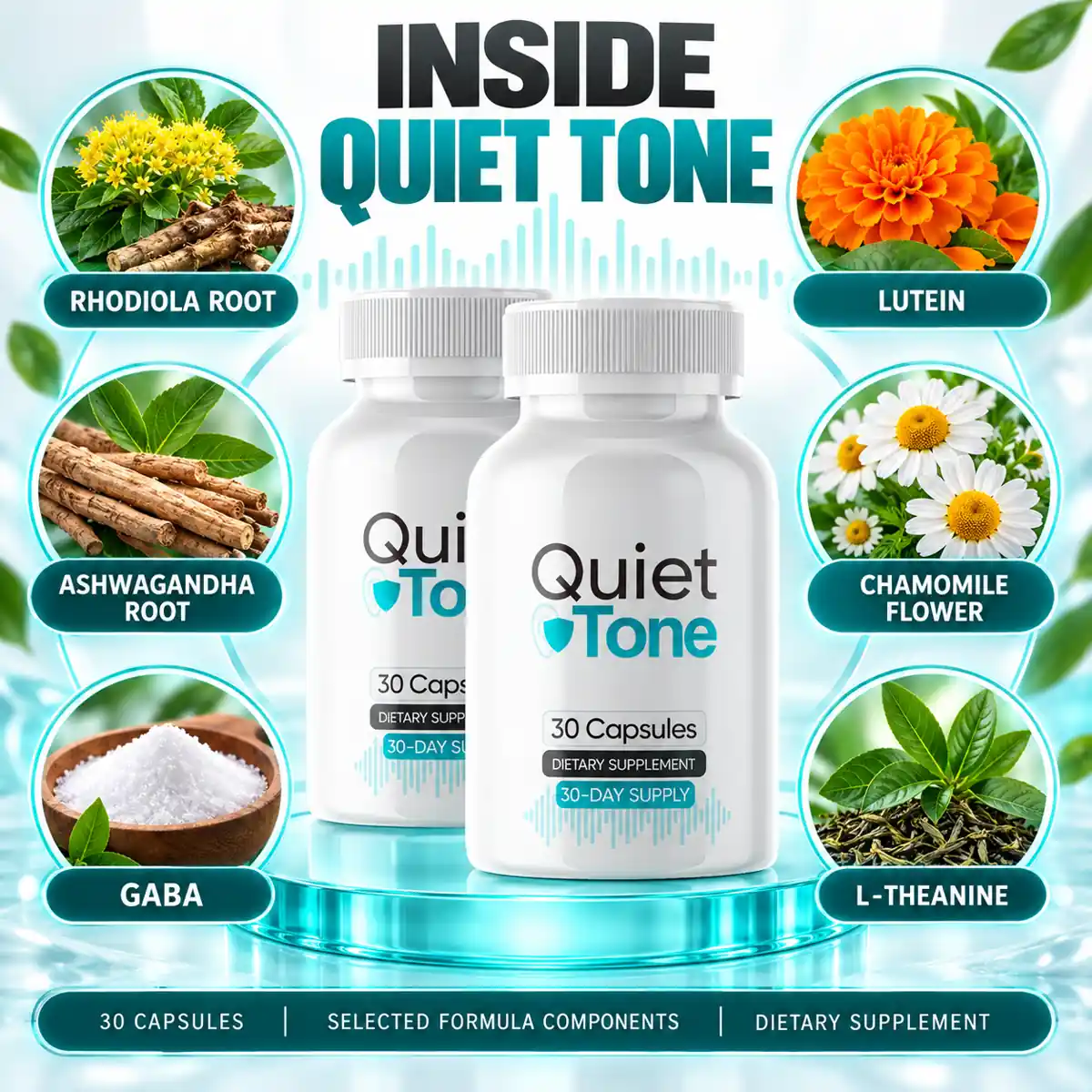
Fourteen of the 18 blend names are the familiar calm-and-sleep group: valerian, hops, passion flower, chamomile, lemon balm, GABA, L-theanine, ashwagandha and others. Their trials measured sleep, stress or anxiety. None measured ringing.
That is a fair proposition on its own. Ringing often feels worse when you are tired or tense, and a formula aimed at rest is aiming at something real. But the trial doses are large. Chamomile used 1,500 mg a day, which is more than three times the whole blend. Ashwagandha used 250 mg and 600 mg a day. Valerian used 530 mg twice a day. L-theanine used 200 mg a day.
Lutein, the second name on the blend list, has its research in the eye, not the ear. The AREDS2 work used 10 mg a day. Ginkgo, the most studied plant in this aisle, is not in the blend at all.
What does the tinnitus guideline say about supplements?
Here is the key line of the AAO-HNSF clinical practice guideline: clinicians should not recommend ginkgo, melatonin, zinc or other dietary supplements to patients with persistent, bothersome tinnitus. Zinc is named in it, and zinc is on this label. A 2026 systematic review of over-the-counter tinnitus treatments looked at the same aisle again, and a Laryngoscope review examined the marketing in it.
The guideline also says what helps. It points to education and counselling, a hearing evaluation, hearing aids where there is hearing loss, sound therapy and cognitive behavioural therapy. None of those comes in a capsule.
A review of tinnitus prevalence put it at roughly 14 per cent of adults. Common does not mean harmless. New ringing, ringing in one ear, ringing that pulses with your heartbeat, or ringing with hearing loss or dizziness all call for an exam first. Earwax is one simple, treatable cause.
Who might still reasonably try Quiet Tone?
A narrow group. Adults over 18 who have had the ringing checked, were told nothing treatable was found, and want to try a calm-and-sleep capsule alongside the steps above. People who take no daily medicine, because St John's wort and 5-HTP are both in the blend at amounts nobody publishes. People who accept that a result may not come.
It is a poor fit for anyone pregnant or nursing, anyone under 18, anyone on hormonal contraception, an antidepressant, a transplant medicine, an anticoagulant, an antiviral or a seizure medicine, and anyone whose ringing is new or one-sided.
If you do try it, count something first. The seller puts the usual wait at 4 to 8 weeks, so give it a bottle before forming a view and two before deciding.
Frequently asked questions
Does Quiet Tone work?
Nobody can say. The finished capsule has never been put through a published trial. The label makes no hearing claim, and the blend amounts are not split. Some of its ingredients have sleep or stress trials at doses the blend cannot be shown to reach.
Does Quiet Tone work for tinnitus?
That is not shown. Only zinc and magnesium have ear research, and both sit well below their trial amounts. The zinc trial concluded zinc is not effective. Quiet Tone is a dietary supplement and is not meant to treat any disease.
What does Quiet Tone do?
It is a once-a-day capsule with nine printed vitamins and minerals and a 415.5 mg blend of 18 botanicals and amino acids. Fourteen of those names are traditional calm-and-sleep ingredients. The label itself states no effect.
Are there before and after results for Quiet Tone?
None are published here. The seller supplies a 4.7 out of 5 summary and eight named comments that cover three different texts. Those describe satisfaction with a purchase, not measured changes in ringing.
Should I see a doctor before trying it?
Yes, if the ringing is recent, one-sided or pulsing, or arrives with hearing loss or dizziness. Ask too if you take any medicine, because the blend contains St John's wort and 5-HTP.
What does the tinnitus guideline recommend instead?
A hearing evaluation, education and counselling, hearing aids where there is hearing loss, sound therapy and cognitive behavioural therapy. Supplements are not on its list for persistent, bothersome tinnitus.
Where does this information come from?
Studies are listed as they are named on the seller's own pages. All product statements trace back to the printed Quiet Tone label and the seller's published terms.
- Tunkel DE, Bauer CA, Sun GH, et al. Clinical practice guideline: tinnitus. Otolaryngol Head Neck Surg. 2014;151(2 Suppl):S1-S40. PMID 25273878. https://pubmed.ncbi.nlm.nih.gov/25273878/
- Tunkel DE, et al. Clinical practice guideline: tinnitus, executive summary. Otolaryngol Head Neck Surg. 2014;151(4):533-41. PMID 25274374. https://pubmed.ncbi.nlm.nih.gov/25274374/
- Menon R, Ziner J, Tolordava A, et al. Effectiveness of Over-The-Counter Treatments for Tinnitus Symptom Relief: A Systematic Review. Laryngoscope Investig Otolaryngol. 2026;11(2):e70398. PMID 41948711. https://pubmed.ncbi.nlm.nih.gov/41948711/
- Vendra V, Vaisbuch Y, Mudry AC, et al. Over-the-Counter Tinnitus "Cures": Marketers' Promises Do Not Ring True. Laryngoscope. 2019;129(8):1898-1906. PMID 30585322. https://pubmed.ncbi.nlm.nih.gov/30585322/
- Jarach CM, Lugo A, Scala M, et al. Global Prevalence and Incidence of Tinnitus: A Systematic Review and Meta-analysis. JAMA Neurol. 2022;79(9):888-900. PMID 35939312. https://pubmed.ncbi.nlm.nih.gov/35939312/
- Tinnitus. MedlinePlus Medical Encyclopedia, U.S. National Library of Medicine. https://medlineplus.gov/ency/article/003043.htm
- Coelho C, Witt SA, Ji H, et al. Zinc to treat tinnitus in the elderly: a randomized placebo controlled crossover trial. Otol Neurotol. 2013;34(6):1146-54. PMID 23598691. https://pubmed.ncbi.nlm.nih.gov/23598691/
- Person OC, Puga ME, da Silva EM, et al. Zinc supplementation for tinnitus. Cochrane Database Syst Rev. 2016;11(11):CD009832. PMID 27879981. https://pubmed.ncbi.nlm.nih.gov/27879981/
- Attias J, Weisz G, Almog S, et al. Oral magnesium intake reduces permanent hearing loss induced by noise exposure. Am J Otolaryngol. 1994;15(1):26-32. PMID 8135325. https://pubmed.ncbi.nlm.nih.gov/8135325/
- Hulshof JH, Vermeij P. The effect of nicotinamide on tinnitus: a double-blind controlled study. Clin Otolaryngol Allied Sci. 1987;12(3):211-4. PMID 2955964. https://pubmed.ncbi.nlm.nih.gov/2955964/
- Mao JJ, Xie SX, Keefe JR, et al. Long-term chamomile (Matricaria chamomilla L.) treatment for generalized anxiety disorder: A randomized clinical trial. Phytomedicine. 2016;23(14):1735-1742. PMID 27912875. https://pubmed.ncbi.nlm.nih.gov/27912875/
- Salve J, Pate S, Debnath K, et al. Adaptogenic and Anxiolytic Effects of Ashwagandha Root Extract in Healthy Adults: A Double-blind, Randomized, Placebo-controlled Clinical Study. Cureus. 2019;11(12):e6466. PMID 32021735. https://pubmed.ncbi.nlm.nih.gov/32021735/
- Zare Elmi HK, Gholami M, Saki M, et al. Efficacy of Valerian Extract on Sleep Quality after Coronary Artery bypass Graft Surgery: A Triple-Blind Randomized Controlled Trial. Chin J Integr Med. 2021;27(1):7-15. PMID 33420602. https://pubmed.ncbi.nlm.nih.gov/33420602/
- Hidese S, Ogawa S, Ota M, et al. Effects of L-Theanine Administration on Stress-Related Symptoms and Cognitive Functions in Healthy Adults: A Randomized Controlled Trial. Nutrients. 2019;11(10). PMID 31623400. https://pubmed.ncbi.nlm.nih.gov/31623400/
- Keenan TDL, Agron E, Keane PA, et al. Oral Antioxidant and Lutein/Zeaxanthin Supplements Slow Geographic Atrophy Progression to the Fovea in Age-Related Macular Degeneration. Ophthalmology. 2025;132(1):14-29. PMID 39025435. https://pubmed.ncbi.nlm.nih.gov/39025435/
Our view
Our answer to the question in the title is: not shown. That is a statement about the evidence, not a verdict on every buyer's experience. The label says nothing about the ear, the ear research on its ingredients is thin, and the better-studied half of the blend was trialled for sleep and stress at amounts the capsule cannot be shown to reach.
Used as a calm-and-sleep capsule with a long refund window, it is a defensible thing to test for an adult who has had their ears checked and has cleared the interactions with a pharmacist. Used as a tinnitus treatment, it asks for more belief than the evidence supports. Our income depends on orders, so check every claim against the sources below, and take medical questions to your doctor or audiologist.
If you try it, try it fairly
A 180-day window leaves room for a proper count. Look at the order page for today's price and the refund terms.
Two bottles $158 · three bottles $207 · six bottles $294 · 180-day money-back guarantee
See today's price and guaranteeDisclosure: this website is paid when an order is placed through it. Quiet Tone is a dietary supplement, not a drug, and it is not FDA approved.